Creating an Online Store: A Practical Guide for UK Sellers
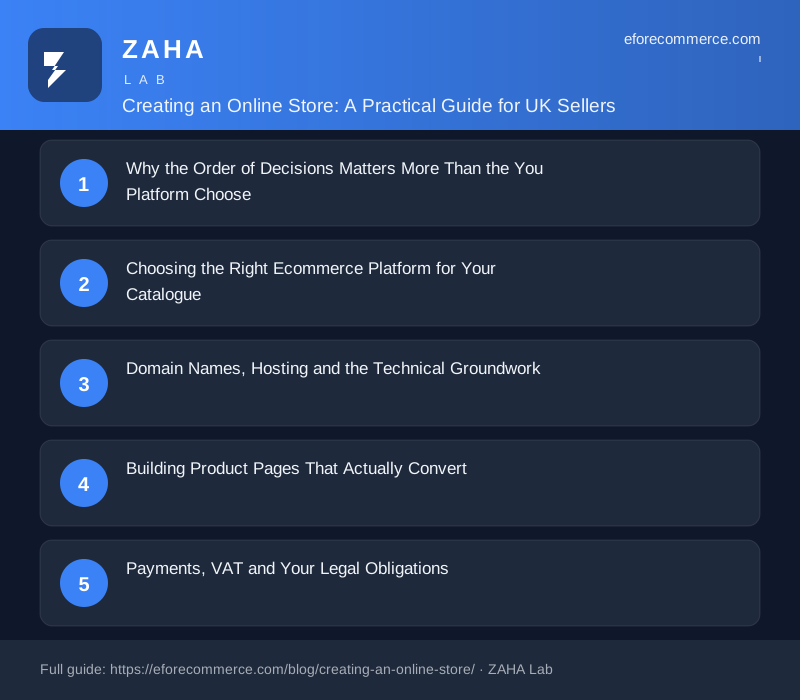
Most new online stores fail within twelve months, not because the products were wrong, but because the foundations were laid in the wrong order. Creating an online store is straightforward once you understand which decisions are reversible and which will cost you serious time and money to undo.
Why the Order of Decisions Matters More Than the Platform You Choose
The single costliest mistake we see UK sellers make is picking an ecommerce platform before they have settled on a business model. Spend three weeks building a beautiful shop, then discover the platform charges transaction fees on every sale, and you are either absorbing a margin hit or migrating everything to a new system. Neither outcome is painless.
Before you touch a website builder, answer these three questions:
- How many SKUs will you sell? A shop with fewer than 50 products has very different platform needs than one with 5,000.
- Will you sell wholesale, retail, or both? B2B and B2C stores have different checkout requirements, minimum order quantities, trade pricing, VAT-exempt customers.
- Do you plan to sell internationally? Multi-currency, international shipping rules and import duty compliance all add technical complexity that some platforms handle well and others handle poorly.
Only once you can answer those questions confidently should you start comparing platforms.
Choosing the Right Ecommerce Platform for Your Catalogue
There is no single best platform for creating an online store. There are platforms that are well-suited to certain types of sellers and poorly suited to others. Here is how to think about the main options.
For sellers with a small, curated product range, typically under 100 products, a hosted platform that handles hosting, security and updates is usually the right call. You are not hiring a developer, you are not managing a server, and the monthly cost is predictable. Most of these platforms charge somewhere between £20 and £70 per month at entry level, with transaction fees ranging from zero to around 2% depending on your payment processor choice.
For sellers with a large or complex catalogue, or those who need deep customisation (bespoke product configurators, subscription billing, trade accounts), an open-source or self-hosted solution gives you more control at the cost of more technical overhead. Expect to either learn the platform in depth or budget for developer time.
For sellers who are testing a product idea and do not want to commit to a full shop yet, a single-product landing page with a payment link can validate demand before you invest in a proper store. There is nothing wasteful about spending a fortnight testing whether people will actually buy before spending three months building the shop to sell it.
Domain Names, Hosting and the Technical Groundwork
This section is not glamorous, but skipping it creates problems that surface at the worst possible times.
Domain name: Buy a .co.uk if you are selling primarily to UK customers. It signals local relevance to both customers and search engines. Keep the domain short, memorable and free of hyphens. If your preferred .co.uk is taken, check whether the brand name is also trademarked before you register an alternative extension, you do not want to build a brand around a name you cannot legally protect.
SSL certificate: Every ecommerce site needs HTTPS. Most hosted platforms include this automatically. If you are self-hosting, ensure it is set up correctly from day one, browsers flag non-secure checkout pages, and that warning will kill your conversion rate.
Business email: Set up a branded email address before you launch ([email protected] or [email protected]). Free webmail accounts on a launch email look unprofessional and create headaches when you need to hand over customer communications to a team member later.
Backup and recovery: Confirm your platform's backup policy before you invest heavily in building the store. How recent is the most recent backup? Can you restore a previous version if something goes wrong? For hosted platforms this is usually handled for you; for self-hosted solutions it is your responsibility.
Building Product Pages That Actually Convert
Traffic without conversion is expensive noise. The difference between a product page that converts at 1% and one that converts at 3% is, all else being equal, three times the revenue from the same number of visitors. That gap is almost always explained by the quality of the product page, not the quality of the product itself.
Here is what consistently separates high-converting product pages from the average:
- Photography that shows scale and context. A product shot on a white background answers "what does it look like?" but not "how big is it?" or "will it suit my home?" Lifestyle images earn their place.
- Descriptions written for the customer, not the catalogue. Describe what the product does and why that matters to the buyer. Bullet points for specifications, prose for benefits.
- Delivery information on the product page itself. Customers should not have to hunt for estimated delivery times. Displaying "Order by 2pm for next working day dispatch" directly on the product page reduces cart abandonment.
- Clear return policy, visible before checkout. In the UK, distance selling regulations give customers a 14-day right to return most goods. Make this a feature, not a footnote. Confidence in returns reduces purchase hesitation.
- Social proof at the point of decision. Reviews, star ratings and user-generated photos placed near the "Add to basket" button, not buried below the fold, measurably increase conversion on most categories.
One practical benchmark: aim for a minimum of three to five product images per SKU and descriptions of at least 150 words. Pages below that threshold tend to underperform both in search rankings and in conversion.
Payments, VAT and Your Legal Obligations
Payment setup is where many new sellers lose money they do not need to lose. Here is the key information.
Payment processors: Most UK ecommerce sellers use one of the major card processors integrated directly with their platform. Look at the total cost of acceptance, transaction fee plus monthly fee plus any currency conversion fee, rather than just the headline rate. At low volumes the difference is small; at £10,000 per month in sales, even a 0.5% difference in fees is £600 per year.
VAT: You are not required to register for VAT until your taxable turnover exceeds the current registration threshold (£90,000 as of 2024, though you should verify the current figure with HMRC directly as it can change). However, if you plan to sell to VAT-registered businesses, registering voluntarily earlier can be commercially sensible. If you sell digital products to consumers in other EU countries, the EU's OSS (One Stop Shop) rules apply, take professional advice before you launch cross-border digital sales.
Consumer law: UK consumer protection law requires you to clearly display your business name and address, a contact method, and full information about prices, delivery and returns before the customer completes a purchase. These are not optional, non-compliance can lead to enforcement action and damaged customer trust.
GDPR and data collection: If you collect email addresses, use cookies, or store customer data, which every ecommerce site does, you need a privacy policy, a cookie consent mechanism, and a process for honouring data subject requests. This applies even to sole traders operating small shops.
Getting Your First Orders Without Wasting Budget
The most common question from new store owners is: "How do I get traffic?" The honest answer is that it depends heavily on your category, your margins and your timeline. But there are principles that hold across most situations.
In the first 90 days, your goal is proof of demand, not scale. You need to establish that real customers will buy, at the price you are charging, using the messaging you have written. Everything else, paid advertising, SEO, social media strategy, comes after that confirmation.
The fastest routes to early validation tend to be:
- Your own network: friends, former colleagues, relevant communities you already participate in (without spamming).
- Targeted paid social: a small budget, perhaps £200 to £500, spent on tightly targeted social ads will generate data much faster than organic methods. The goal at this stage is clicks and conversions, not brand awareness.
- Marketplace testing: listing your product on an established marketplace alongside your own store lets you test price sensitivity and demand without relying solely on your own traffic.
For longer-term growth, search engine optimisation is almost always the highest return channel for product-led ecommerce businesses in the UK. The compounding nature of organic search traffic, where content you create today can continue driving visits for years, gives it a structural advantage over paid channels. But SEO takes time; most new domains see meaningful organic traction after six to twelve months of consistent effort, not weeks.
Build your email list from day one. Even if you have only 50 subscribers, the habit of capturing and communicating with customer email addresses is one of the most valuable things you can build. Owned channels are more resilient than rented ones.
Common Mistakes to Avoid When Creating Your Store
We have seen enough UK ecommerce launches to recognise the patterns that cause problems. The most avoidable ones:
- Launching with too many products. A focused range of 10 to 20 well-photographed, well-described products will outperform a sprawling catalogue of 200 poorly presented ones. Edit ruthlessly at launch.
- Underestimating fulfilment. Packing and dispatching orders takes real time. Before you launch, work out exactly how you will fulfil an order placed at 7pm on a Friday and whether that process is sustainable at 10x current volume.
- Setting prices too low. New sellers often underprice to compete, then discover their margins cannot cover returns, damaged goods, customer service time and any marketing spend. Work backwards from a sustainable margin before you set your prices.
- Neglecting mobile. In the UK, a significant majority of ecommerce browsing happens on mobile devices. Test your entire checkout journey on a phone, including the payment step, before you launch.
- Skipping analytics setup. Install your analytics before you drive a single visitor. Without data, you cannot diagnose what is working and what is not.
Frequently Asked Questions
How much does it cost to create an online store in the UK?
The minimum viable cost for a basic hosted store, platform subscription, domain name, and a small initial product photography investment, is typically somewhere in the range of £300 to £600 for the first year, assuming you do the setup yourself. More complex stores with custom development, professional photography and initial advertising budget can easily reach several thousand pounds. The largest variable is whether you hire developers or do the technical work yourself.
Do I need a business bank account to run an online store?
You are not legally required to have a separate business bank account if you are a sole trader, but it is strongly advisable. Mixing personal and business finances creates significant complications at tax time and makes it much harder to understand your true profit and cash position. Most major UK banks offer business current accounts, and several challenger banks offer low-cost options well-suited to small ecommerce operations.
How long does it take to create an online store?
A basic store using a hosted platform can be technically live within a day or two for a seller who already has product photography and copy prepared. In practice, most sellers take two to six weeks from deciding to launch to actually launching, accounting for photography, writing product descriptions, setting up payment processing, testing the checkout, and handling the legal requirements. Rushing this process tends to result in a launch that requires immediate remediation, it is almost always worth taking the extra week to do it properly.
Disclosure: this post contains affiliate links. If you join through one of them we earn a commission, at no extra cost to you. It does not change what we recommend.
Building the money skills behind the store
The operational side of ecommerce, sourcing, pricing, fulfilment, is only half of it. The other half is the financial literacy to read your own numbers, understand cashflow, and make decisions about credit, tax and reinvestment without guessing. That is the part most sellers develop last, and it is the part that decides whether a growing store becomes a durable business.
We use Money.School for this. It is a membership built around practical money education, cashflow modelling, credit and borrowing, margins, tax and reinvestment — taught by people who have actually scaled businesses rather than only theorised about it. It suits sellers who want a structured, ongoing education rather than a one-off course.
- Standard Monthly, £15 + VAT a month
- Standard Yearly, £150 + VAT a year
- Standard Lifetime, £300 + VAT one-off
- GOLD Monthly, £38.33 + VAT a month
- GOLD Yearly, £380 + VAT a year
- GOLD Lifetime, £760 + VAT one-off
The monthly tiers are the low-commitment way in; the lifetime options suit anyone who wants permanent access. If you are weighing it up, start with a monthly plan and judge it against your own numbers.