How to Sell on TikTok: The Complete Guide for UK Ecommerce Sellers
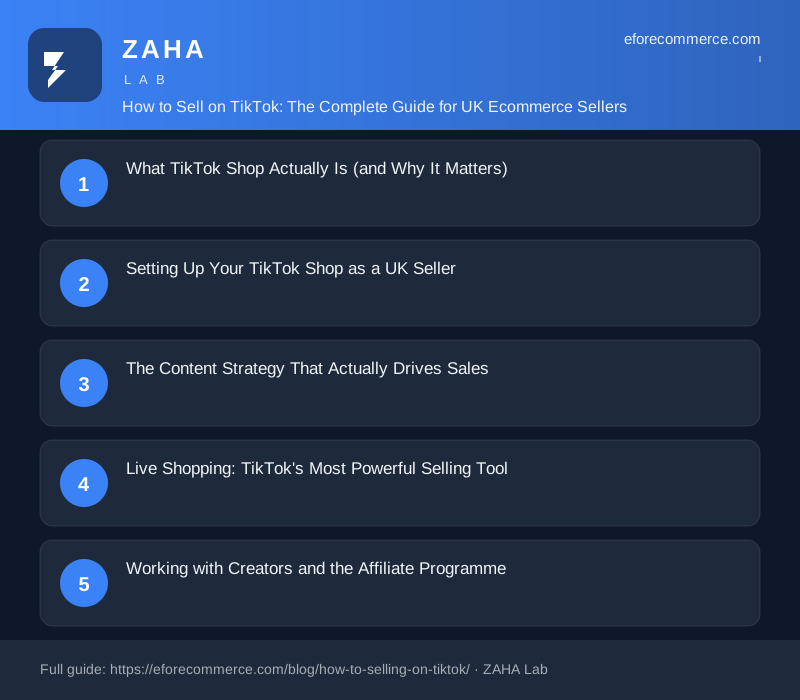
Sellers who dismiss TikTok as a platform for teenagers are quietly watching their competitors move serious product volume there. Knowing how to sell on TikTok is now a core ecommerce skill, the platform has become a full-stack shopping destination, not just a traffic source, and UK sellers who act now have a meaningful first-mover edge before the market matures.
What TikTok Shop Actually Is (and Why It Matters)
TikTok Shop is the native commerce layer built directly into the TikTok app. Unlike Instagram or Pinterest, where a click takes a user to an external product page, TikTok Shop allows customers to browse, add to basket, and complete checkout without ever leaving the platform. That frictionless journey matters enormously, every redirect you remove from the path to purchase improves conversion.
The model has three distinct selling surfaces: short-form video with shoppable product tags, live shopping streams, and a dedicated Shop tab where customers can browse by category. All three feed the same inventory, so a single product listing can generate sales across multiple formats simultaneously.
For UK sellers, TikTok Shop launched fully in 2021 and has grown substantially since. It sits under a regulatory framework that treats sellers as marketplaces participants, so standard UK consumer rights legislation, including the 14-day right of return, applies in full.
Setting Up Your TikTok Shop as a UK Seller
The entry point is TikTok Seller Center, TikTok's dedicated merchant dashboard. Registration requires a UK business bank account, proof of business registration (Companies House number for limited companies, or sole trader documentation), and a valid government-issued ID for the account holder. The verification process typically takes two to five working days.
Once approved, product listings are created directly within Seller Center. Each listing needs:
- A title of up to 34 characters that leads with the most searchable terms
- High-quality product images on a clean background (TikTok recommends square format at 800×800 minimum)
- A detailed description that covers materials, sizing, and care where relevant
- Accurate weight and dimensions for shipping calculations
- A mapped product category, which determines which affiliate creators can find your listing
- A competitive price inclusive of VAT, as TikTok displays all prices as consumer-facing totals
Fulfilment is handled either by the seller directly or through TikTok's Fulfilled by TikTok (FBT) programme, which operates similarly to FBA. For sellers already running FBA operations, the warehouse management logic will feel familiar. For those shipping from their own facility, TikTok integrates with the major UK courier APIs, and label printing is handled inside Seller Center.
The Content Strategy That Actually Drives Sales
This is where most sellers stall. They build a tidy Seller Center account, upload their products, then wait. Nothing happens. TikTok Shop is not a passive catalogue, it is a demand-generation engine that rewards consistent content output.
The platform's algorithm distributes content based on engagement signals, not follower count. A new account with zero followers can achieve meaningful reach within its first week if the content triggers replays, comments, or shares. That is a genuinely unusual characteristic compared to any other major platform, and it levels the playing field for smaller sellers.
The content format that converts best is what practitioners call "discovery video", a short clip (typically 30 to 60 seconds) that surfaces the product in a context the viewer finds genuinely interesting or useful. The hook must land in the first two seconds. If a viewer scrolls past, the algorithm interprets that as a negative signal. A video that opens with the product in use, a problem being solved, or an unexpected visual detail will hold attention longer than a clip that opens with a logo or a price.
Product tags can be applied to any video on a creator account linked to the shop. When a viewer taps a tag, they go directly to the product page within the app. We consistently see that tagged videos with strong organic reach generate purchase intent that static listings cannot manufacture on their own.
A realistic content cadence for a seller starting out is three to five original videos per week. Quality matters more than volume, but regularity matters more than perfection. Posting one video per fortnight sends the algorithm a dormancy signal; posting daily with inconsistent quality tends to perform better than intermittent polished output.
Live Shopping: TikTok's Most Powerful Selling Tool
Live commerce is the format that most distinguishes TikTok Shop from any other UK ecommerce channel. A seller goes live, either from a phone or a laptop with streaming software, and presents products in real time. Viewers can tap the product pinned to the stream, open a product card, and purchase without leaving the live video.
The economics of live shopping can be compelling, particularly for products that benefit from demonstration: skincare, food, craft supplies, fitness equipment, clothing. Products that are difficult to explain in a static image, where seeing the texture, the scale, or the application answers the customer's key questions, convert particularly well in live format.
Live streams that perform well share a few structural features. They run for a minimum of 60 to 90 minutes, because the algorithm tends to push live content to more viewers as a stream matures. They pin and unpin products to create a rotation that keeps repeat viewers engaged. And they use a scripted framework with natural-feeling delivery rather than rigid corporate presentation. The tone that works on TikTok is conversational, direct, and honest about what a product is and is not.
UK sellers should note that TikTok's algorithm rewards live streams that maintain high concurrent viewer counts relative to the total number of people who've entered the stream. Keeping viewers engaged throughout, through Q&A, limited-time offers pinned to the stream, or interactive polls, improves distribution more reliably than trying to drive peak traffic at the start.
Working with Creators and the Affiliate Programme
TikTok's affiliate model is one of the more efficient creator marketing tools available to UK ecommerce sellers. Through Seller Center, you can open your products to a network of TikTok creators who can apply to promote them in exchange for a commission on each sale they generate.
Commission rates are set by the seller and are typically in the range of 5% to 20%, depending on the product category and margin. A creator makes content featuring the product, tags it, and earns their commission on tracked sales. The seller gets organic-feeling content produced at no upfront cost and pays only on performance.
The key to making affiliate work is selecting products with enough margin to absorb commission whilst remaining price-competitive, and setting commission rates that make the product worth a creator's time. A product priced at £15 with a 10% commission generates £1.50 per sale, that may appeal to a creator building volume, but is unlikely to attract creators with large audiences who can command higher rates elsewhere.
Targeted outreach to creators in your product niche, through TikTok's Creator Marketplace, tends to outperform open-plan listings. Identify creators whose existing content resonates with your likely customer, check their engagement rate (not just follower count), and approach with a clear brief about what you're selling and what commission you're offering.
TikTok Ads: When to Invest and What to Expect
Paid advertising on TikTok for ecommerce runs through TikTok Ads Manager, which is separate from Seller Center but links to it for shopping campaigns. The main formats relevant to product sellers are In-Feed Ads (video ads that appear in the main feed), Video Shopping Ads (which surface shoppable content to defined audiences), and LIVE Shopping Ads (which promote active live streams).
The minimum daily budget for a campaign is typically £20, though effective results often require higher daily spend to generate statistically meaningful data within a reasonable testing window. TikTok advertising generally requires a creative-first approach, if the video content is weak, no amount of targeting precision will rescue a campaign. The platform rewards ads that look and feel like organic content rather than traditional digital display.
We would recommend building a foundation of organic content and some affiliate activity before committing significant paid budget. Organic engagement data tells you which products and content styles resonate, running paid traffic against an already-validated asset is a more efficient use of budget than testing both variables simultaneously.
Common Mistakes UK Sellers Make on TikTok Shop
The most frequent errors we observe from sellers entering TikTok Shop for the first time follow predictable patterns. Understanding them in advance saves considerable wasted effort.
Treating TikTok like a product catalogue. Sellers who list products and expect browsing behaviour similar to Amazon or eBay are disappointed. TikTok drives impulse-led demand through content; it does not replace search-led intent marketplaces, it complements them.
Underpricing to win volume. Because TikTok's visible pricing is consumer-facing and inclusive of VAT, and because platform fees and affiliate commissions sit on top of fulfilment costs, margin calculation needs to be done carefully before setting a live price. Sellers who migrate Amazon prices directly without accounting for TikTok's cost structure often find they are selling at a loss.
Neglecting customer service SLAs. TikTok monitors seller response times and despatch rates and uses these metrics in ranking decisions. A shop that is slow to respond to messages or consistently late dispatching orders will see its content suppressed in Shop tab recommendations, regardless of how strong the content is.
Ignoring returns policy presentation. UK consumer law entitles customers to a 14-day return window, but sellers who make the returns process difficult, unclear instructions, slow refunds, unresponsive support, generate negative reviews that compound quickly on a platform where social proof is prominently displayed.
Frequently Asked Questions
Do I need a large following to start selling on TikTok Shop?
No. TikTok Shop does not require a minimum follower count for the seller account itself. Because TikTok's algorithm distributes content based on engagement rather than existing audience size, it is possible to generate sales from a new account with no existing following, provided the content is relevant and engaging. Building an audience helps over time, but it is not a prerequisite for opening the shop or making early sales.
How much does it cost to sell on TikTok Shop in the UK?
TikTok charges a referral fee, essentially a commission on each completed sale, which varies by product category, but is currently around 5% for most categories, with some variation. There are no monthly listing fees. Additional costs to factor in include fulfilment, packaging, any affiliate commissions you set, and optional advertising spend. TikTok has periodically adjusted its fee structure since launch, so it is worth reviewing the current rates in Seller Center before finalising your pricing.
Can I sell on TikTok Shop alongside my other sales channels?
Yes, and for most sellers this is the right approach. TikTok Shop operates as an additional channel rather than a replacement for existing marketplaces or a direct-to-consumer website. Inventory can be managed separately within Seller Center, and you are not obliged to list your entire product range, many sellers start with a curated selection of products that are well-suited to video demonstration before expanding. There is no exclusivity requirement from TikTok's side.
Disclosure: this post contains affiliate links. If you join through one of them we earn a commission, at no extra cost to you. It does not change what we recommend.
Building the money skills behind the store
The operational side of ecommerce, sourcing, pricing, fulfilment, is only half of it. The other half is the financial literacy to read your own numbers, understand cashflow, and make decisions about credit, tax and reinvestment without guessing. That is the part most sellers develop last, and it is the part that decides whether a growing store becomes a durable business.
We use Money.School for this. It is a membership built around practical money education, cashflow modelling, credit and borrowing, margins, tax and reinvestment — taught by people who have actually scaled businesses rather than only theorised about it. It suits sellers who want a structured, ongoing education rather than a one-off course.
- Standard Monthly, £15 + VAT a month
- Standard Yearly, £150 + VAT a year
- Standard Lifetime, £300 + VAT one-off
- GOLD Monthly, £38.33 + VAT a month
- GOLD Yearly, £380 + VAT a year
- GOLD Lifetime, £760 + VAT one-off
The monthly tiers are the low-commitment way in; the lifetime options suit anyone who wants permanent access. If you are weighing it up, start with a monthly plan and judge it against your own numbers.